
New: InfoDump Mobile brings governed private AI access to the phone.
Read announcementBlog
Notes on AI governance, privacy, and reusable agents
High-level writing for teams adopting AI without losing control of data, policy, access, or accountability.
Featured
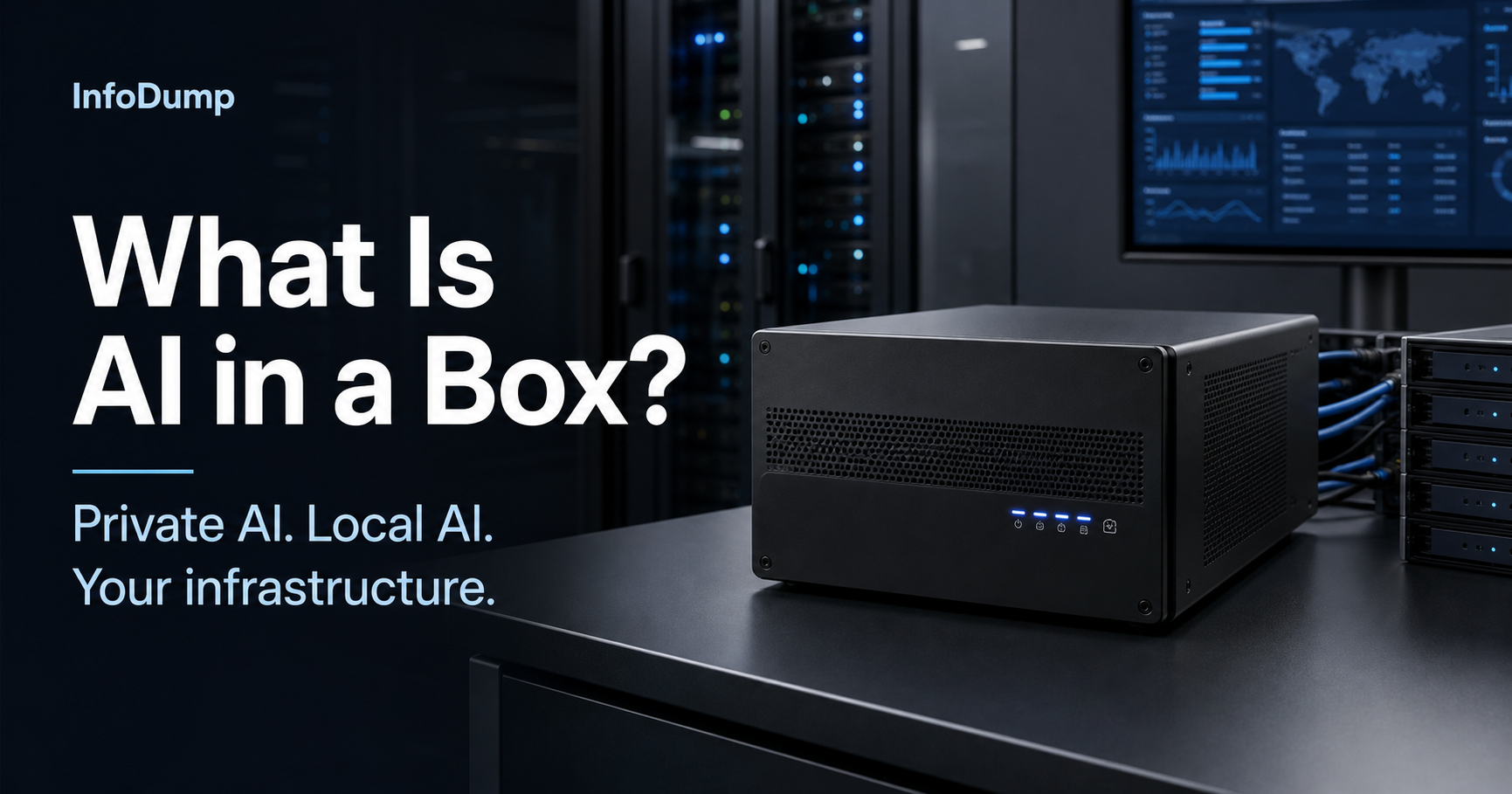
What Is AI in a Box?
Learn what AI in a Box means, how local AI appliances work, and why organizations use on-premises AI to keep models, documents, and data under their control.
Serious LLMs by Country
A curated country-by-country shortlist of serious public large language models with links to their Hugging Face model pages.
InfoDump Announces InfoDump Mobile for Private AI Access From Your Phone
InfoDump Mobile gives teams a governed mobile interface for private AI work, connecting phone-based workflows to an organization's controlled AI environment.
AI Interaction Cost Calculator
Compare recurring cloud AI spend with running private AI interactions locally through InfoDump and InfoDump Models.
InfoDump Announces SLM Studio, a Local App for Building Role-Specific Small Language Models
InfoDump SLM Studio helps non-technical teams define roles, generate examples, evaluate behavior, train, package, and test role-specific small models through a local desktop workflow.
Everyone Wants to Turn On AI, But Their Foundation Is Not Ready
Use this interactive AI readiness assessment to decide whether your organization should enable, pilot, restrict, or decline an enterprise AI feature.
What Is an AI Governance Layer?
An AI governance layer gives organizations a practical control point for privacy, policy enforcement, data ownership, and visibility across ChatGPT, LLMs, and AI tools.
RFP Responses Need AI Speed and Governance Discipline
RFP work is a natural fit for AI, but response teams need controlled source access, privacy guardrails, and reviewable outputs.
Why AI Governance Should Sit Between People, Models, and Data
AI governance works best when it is close to the actual work: where people, models, agents, and organizational knowledge meet.
The Case for Reusable AI Operators Inside Organizations
Reusable AI operators can turn working processes into governed patterns that teams can duplicate, adapt, and improve.
Hosted LLMs, Local LLMs, and the Future of Data Ownership
Model choice matters, but governance should focus on ownership, access, retention, and control across hosted and local AI systems.
The Problem With Letting Every Team Bring Their Own AI Tool
Uncoordinated AI adoption creates hidden risk: unclear data exposure, inconsistent permissions, and weak visibility into operational work.
AI Adoption Fails When Teams Cannot See What Agents Can Access
Trust improves when agent access, permissions, and output expectations are visible before repeatable work begins.
What Makes an AI Agent Safe Enough for Work?
Useful agents need more than prompts. They need clear purpose, source boundaries, allowed tools, review paths, and accountable outcomes.
From Ideas To Governance
Ready to make AI adoption easier to govern?
Talk with InfoDump about privacy, policy enforcement, AI usage monitoring, and data ownership before unmanaged workflows become the default.